RAG Systems Explained: What Business Owners Need to Know in 2026
You’ve probably heard that AI can answer questions, generate content, and automate tasks. But if you’ve ever asked ChatGPT a question about your company’s internal policies or last quarter’s sales data, you’ve discovered the limitation: general-purpose AI doesn’t know anything about your business.
Retrieval-Augmented Generation — or RAG — solves this problem. It’s the technology that lets AI answer questions using your company’s actual documents, databases, and knowledge bases instead of relying on generic internet training data.
This guide explains how RAG works in plain language, when it makes sense for your business, and what to consider before investing.
How RAG Works (Without the Jargon)
Think of RAG as giving an AI assistant a filing cabinet of your company’s documents before it answers a question.
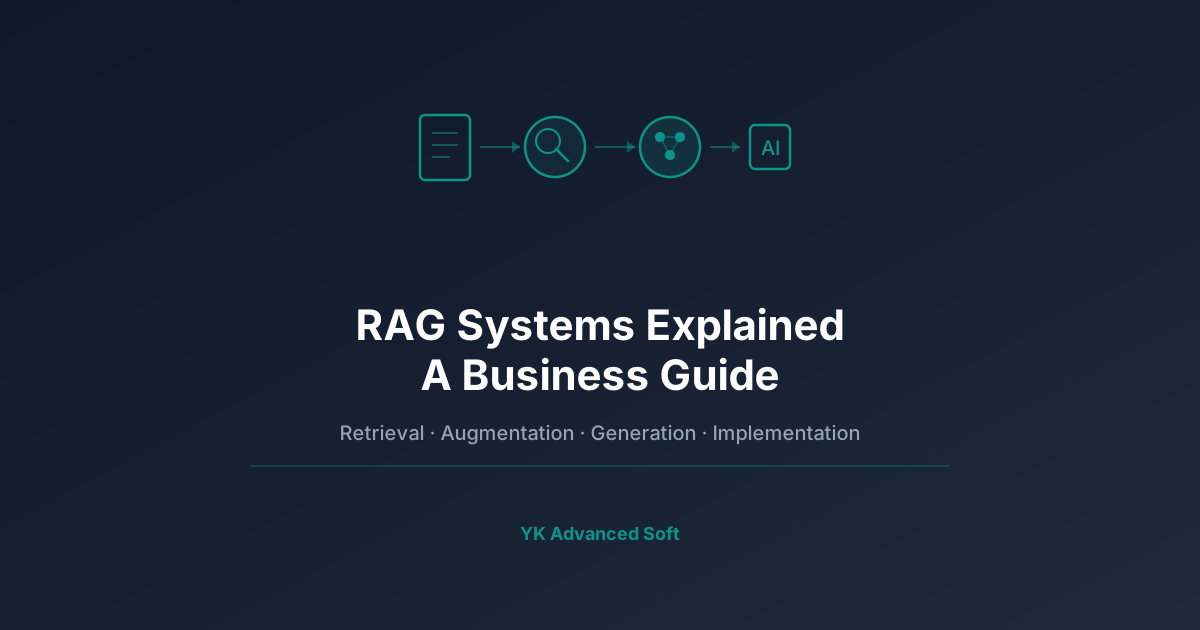
Here’s the process in three steps:
-
Your documents are prepared. Company policies, product manuals, contracts, knowledge bases, and other documents are processed and stored in a searchable format (a vector database). This happens once during setup and is updated as documents change.
-
A question comes in. When someone asks the system a question — “What’s our return policy for enterprise clients?” — the system first searches your document library to find the most relevant sections.
-
The AI generates an answer using your data. The retrieved documents are provided to the language model as context. The AI then generates a response grounded in your actual information, not generic training data. It can even cite which documents it used.
The result: answers that are specific, accurate, and grounded in your organization’s real information.
How RAG Differs from Standard AI
Standard LLMs (like ChatGPT or Claude used without RAG) generate responses based on their training data — essentially a snapshot of the internet. They don’t know about your company’s internal processes, proprietary data, or recent changes.
RAG changes the equation. Instead of relying solely on training data, the AI retrieves relevant information from your sources at the moment a question is asked. This means the system stays current as your documents are updated, can answer questions about proprietary information it was never trained on, and provides verifiable answers with source citations.
For businesses, this distinction is critical. You need AI that reflects your reality, not the internet’s general knowledge.
Five Real Business Use Cases
1. Customer Support Automation
A RAG-powered support system can answer customer questions using your actual product documentation, FAQ database, and support ticket history. Instead of generic responses, customers get answers specific to your products, pricing, and policies. Companies using RAG-based support typically see 40–60% reduction in tickets escalated to human agents.
2. Internal Knowledge Bases
New employees spend weeks figuring out internal processes. A RAG system trained on your company handbook, SOPs, and Confluence pages lets anyone ask questions and get instant, accurate answers. “How do I submit an expense report?” gets answered with your actual process, not a generic template.
3. Legal and Compliance Document Search
Law firms and compliance teams spend hours searching through contracts, regulations, and case files. RAG systems can search across thousands of documents and return specific answers with citations — turning hours of research into seconds. “What are the termination clauses in our vendor contracts signed in 2025?” becomes a query, not a project.
4. Medical Record and Clinical Data Querying
Healthcare organizations use RAG to build systems that let clinicians query patient histories, treatment protocols, and medical literature. Combined with HIPAA-compliant infrastructure, these systems improve care quality while reducing the time clinicians spend searching for information. If you need AI solutions for healthcare, RAG is often the foundation.
5. Sales Enablement
Sales teams need instant access to product specifications, competitive analyses, case studies, and pricing guidelines. A RAG system trained on your sales materials lets reps ask questions like “What’s our advantage over Competitor X for mid-market healthcare clients?” and get an answer grounded in your actual competitive intelligence — not a hallucinated response.
Implementation Considerations
Before building a RAG system, evaluate these factors:
Document Quality Matters
RAG is only as good as the documents it retrieves. If your knowledge base is outdated, contradictory, or poorly organized, the AI’s answers will reflect that. Most RAG projects start with a document audit and cleanup phase.
Choosing the Right LLM
Not every use case needs the most powerful (and expensive) model. Simple FAQ retrieval might work well with a smaller, faster model, while complex document analysis may require a more capable LLM. A good AI automation partner will help you select the right model for each task based on cost, speed, and accuracy requirements.
Security and Access Controls
If your documents contain sensitive information — financial data, HR records, client details — your RAG system needs role-based access controls. Not every user should be able to query every document. This is especially critical in regulated industries like healthcare and finance.
Ongoing Maintenance
RAG systems aren’t set-and-forget. Documents change, new information is created, and the system needs regular updates to stay accurate. Budget for ongoing document ingestion and periodic accuracy reviews.
Is RAG Right for Your Organization?
RAG makes sense when:
- Your team spends significant time searching for information across scattered documents
- You need AI that gives answers specific to your organization, not generic responses
- Your knowledge base is large enough that manual search is a bottleneck
- You want AI-generated answers that can be verified against source documents
RAG may not be the right fit if your information needs are simple enough for a traditional search engine or FAQ page, or if your document library is too small or disorganized to provide value.
Getting Started
The most successful RAG implementations start small. Choose one high-value use case — typically customer support or internal knowledge management — build a pilot system, measure the results, and expand from there. Organizations with complex data environments often benefit from an enterprise application development approach that integrates RAG into their existing systems architecture. Starting with a focused scope lets you validate the technology with real users before investing in a company-wide deployment.
The organizations getting the most value from RAG in 2026 are not the ones with the most sophisticated technology — they’re the ones that started with a clear business problem and built a focused solution around it.